I am about to open a whole big can of worms and here it is... you CAN drink cappuccino after 10 am in Italy! My native Italian and I do it all the time, though I will clarify there are a few caveats:
1) It is still not cool to drink cappuccino with lunch or any meal aside from breakfast. The thought of drinking all that milk with non-sweet food will freak them out for sure.
2) While it is not frowned upon if you drink it any time of day as a "break" kind of snack, the other sweet spot for having a cappuccino is between 4 and 5 in the afternoon. It is well before aperitif time so it won't hinder your early evening spritz.
3) If it is after 10 am - have it as a stand-alone drink or with a cookie/pastry. see #1
Ok, whew, I feel better.
I realize this is the exact opposite advice from every other expat out there, but this is my Italy. True, every region is different but Times, they are a changing. And I have yet to hear a barista lecture my native Italian speaker when he orders it.
More later...
Showing posts with label culture. Show all posts
Showing posts with label culture. Show all posts
Monday, November 04, 2013

Tuesday, October 22, 2013
La Biennale, Venice
 |
| Model of the Encyclopedia Palace |
The cinema aspect of La Biennale takes place every year as the Venice Film Festival. Music, theater and dance exhibitions are much smaller and don't last as long as the primary two. The festival also has kid and family friendly activities, so check the website for a calendar of events.
This year, 2013, is the International Art Exhibit - but what is it exactly you might ask? It is the most prestigious art exhibit in the world. You will find art from over 150 artists from 37 countries, as well as 88 national participants - meaning in addition to the individual artists, 88 countries have their own rooms or pavilions to display national offerings. It is spread in two main areas of Venice - the Giardini and the Arsenale. The Giardini is in the eastern part of Venice and contains the main Central Pavilion showcasing individual artists as well as 29 national pavilions spread throughout the garden. The Arsenale is a HUGE collection of buildings that date back to the 13th century where boats were built and armed for the military of the Serenissima. It was really the first assembly-type production center of the world. It's an interesting place to see in and of itself, and now is used to host exhibits.
My Italian looks forward to this festival every year, whether art or architecture, he cannot wait to see what's on display. So, this past weekend we hopped on the train and headed to Venice to see what's what. There is so much to see that you can't do it all in one day; so the ticket you buy is good for two days - when you purchase the ticket make sure you get the right one, one is for 2 consecutive days, and another is for any 2 days be they consecutive or not. We decided to see the Arsenale first as I had not seen the area since it was renovated. It was very interesting - not only seeing the venue which consists of beautiful huge spaces, but also seeing the art. This year's theme is "Il Palazzo Enciclopedio" (The Encyclopedia Palace) which is based on an imaginary museum meant to hold all worldly knowledge. Marino Auriti had this dream and actually wanted to build a 136-story building in Washington that would take up over 16 blocks. While that building could not be built, the idea also correlates with the idea of "building" memory palaces, or memory maps, a technique used both in ancient times and today for remembering information. I don't know that much about art (especially modern art) or memory maps, but it did what art is supposed to do. It makes you think.
Here are a few pics what we saw; click on my Instagram icon to see a few more.

More later...
Wednesday, September 25, 2013
OTBP: Bassano del Grappa (Veneto)
I’ve decided to start a series on the blog called “Off the
Beaten Path”, or OTBP (cuz I’m lazy), where I showcase a lesser-known town
mostly in the Veneto region. The big tourist attractions are wonderful and
important to see, but Italy has so much more to offer if you can take the time
to wander the less traditional areas. Today, let’s visit Bassano del Grappa.
Bassano del Grappa is in the Vicenza province of the Veneto. It’s a very old city at the base of the Pre-Alp mountain area and runs along the Brenta River. One of the most recognizable symbols of the city is the Ponte degli Alpini, which is a wooden pontoon bridge designed by Andrea Palladio in 1569. The Alpini are an elite mountain infantry group that was created to protect Italy’s northern mountain border.
Because of
the geography of the city, the town has been on the forefront of many wars – it
was hit hard during The French Revolution (Napoleon stayed in the city for several
months), World War I (The Great War) and World War II - battle scars can still
be seen today. As a result, the Ponte
degli Alpini has been rebuilt several times, most recently after WW2, where
the Alpine soldiers funded the rebuilding through private collections. As an aside for literature buffs, Ernest
Hemingway spent some time in Bassano during his stint as an ambulance driver in WW1. Several parts of his book “A Farewell to Arms” were set here.
 |
| Entrance to bridge - Ponte degli Alpini |
Bassano del Grappa is in the Vicenza province of the Veneto. It’s a very old city at the base of the Pre-Alp mountain area and runs along the Brenta River. One of the most recognizable symbols of the city is the Ponte degli Alpini, which is a wooden pontoon bridge designed by Andrea Palladio in 1569. The Alpini are an elite mountain infantry group that was created to protect Italy’s northern mountain border.
 |
| ...those are bullet holes folks... |
Aside from its war-time history, Bassano del Grappa
is also famous for something else – Grappa. Grappa is a highly alcoholic
beverage made from distilling all the leftovers from making wine – leaves,
stems, pulp, etc. It’s usually drunk as
a digestivo (after-dinner drink) and
is also frequently added to espresso for a caffe’
corretto. A well-known Grappa maker is Nardini,
who has a very cool space-agey distillery near town that offers a guided tour
and samples, in addition to a shop on the Ponte
degli Alpini which displays old distillery vats, equipment, etc. and sells
the spirit. Be warned, Grappa is very
strong – you can “feel the burn” all the way down when you drink it J.
 |
| Palazzo Sturm - Museo Remondini |
 |
| Monument on Mount Grappa |

More later…
Thursday, August 15, 2013
The Tears of San Lorenzo…
Every year around August 10th, Italians flee to
higher ground and look to the stars. Why, you might ask? It is San Lorenzo’s day and
it falls during the period of the Perseid Meter Shower
– which means, a sky full of shooting stars and for Italians: The Tears of San
Lorenzo.
Not growing up Catholic, I knew very little about San
Lorenzo (Lawrence) or really any other saints. He is a beloved saint to
Italians who was the “keeper of the treasures of the church” in the early 3rd
century and when asked by the Roman Prefect to present that treasure - what he
presented were people – the sick, the poor, and the weary. You see, he had
distributed the church’s treasure to the poor and needy instead of handing it
over to the Romans. This enraged the Prefect, he arrested Lorenzo and according
to legend, had him roasted alive on a grill over burning coals. The shooting
stars during this meteor shower are said to represent the tears he shed while
being roasted, thinking about the people he considered far more valuable
“treasures” than the jewels and gold that had been in the coffers.
So in honor of this beloved saint, on August 10th,
Italians flee the city and find a spot to watch the astrological show. There
are usually many star gazing events on this day – dinners and events that take
place away from the city lights. We live near the beautiful Euganean Hills (Colli Euganei)
so went up to a lovely spot called CasaMarina and with about a dozen or so other people, watched the sky for the
shooting stars. This year, the peak of the shower is around the 11th
- 12th so there weren’t too many shooting stars to see yet, though
we did managed to see about 4 – which to be honest, is more than this city girl
had ever seen in her lifetime. Luckily for us, it was a gorgeous night, with
clear skies, a million stars, and a nice pleasant breeze. And while we will go
back up around the peak to see more, it was awesome to connect to the culture
by following this tradition that Italians have been doing for years.
So, if you find yourself in Italy mid-August around the 10th,
check your local papers and tourist offices – find out where to go for the best
view of the sky, or see what events are planned that night. It’s a great way to
experience local culture, you might even happen upon a small group of
astronomers who will let you look through their telescope J and who can pass up on a magical night full
of shooting stars. I’ve made my wishes,
you should too.
More later…
Sunday, February 08, 2009
Discovering Italy

Today we are going to visit Sabbioneta. It is located in Northern Italy on the plains between the Po and Oglio Rivers. In 2008, Sabbioneta was added as a UNESCO World Heritage site (along with Mantova).
Regione: Lombardia
Provincia: Mantova
City: Sabbioneta
Known as “The Ideal City,” Sabbioneta was the brain-child of one man, Vespasiano Gonzaga Colonna, who was from a branch of the famous Gonzaga family,
 Dukes of Mantova. This city was designed based on the theories of ideal city planning and built in the second half of the 16th Century. The design of the city represents the functional vision of the Renaissance period, which relied heavily on the use of proportions derived from observing Roman ruins. The rediscovery of ancient books, the theory of the Greek “Golden Ratio” and Neoplatonism also helped shape the Renaissance city planning. The outline of the city is shaped by fortifications in an irregular hexagon form with 6 bastions at the corners, much of which is well preserved.
 In this city, Vincenzo Scamozzi was hired to construct the Teatro all’antica. Scamozzi was a student of Andrea Palladio, and one of the most important architects of his time. The Teatro all’antica is very important in the history of theater, as it was the first indoor theater built specifically that purpose and served as a model for the European theaters that followed. Sabbioneta also hosted an important Jewish community and Hebrew printing press, which you can still visit today. Other places of interest include the Palazzo del Giardino, Galleria della Antichi, Palazzo Ducale, various churches, the remaining bastions, Porta Vittoria – the most ancient entrance of the town - and the Sinagoga, (the synagogue).
Food. You can’t visit a city without experiencing the food. (plus it’s the best part of any trip!) Let’s start with my favorite part of the meal – dessert. Torta sbrisolona, literally “crumb cake” is a local specialty made with almonds. Traditionally dipped in wine, but coffee or hot chocolate work too. YUM. Pasta - Tortelli mantovani di Zucca. Tortelli are kind of like large ravioli, in this dish filled with a pumpkin/amaretti filling. (I haven’t tried it but next time I will and report back!) Wine – Lambrusco sabbionetano is a red wine using only local grapes grown in the area’s sandy soil.
It is a lovely city with a lot of interesting things to see. For me, part of the intrigue is the fact it was built just to embody the Renaissance thoughts of the time. If you are in the area, take the time to stop by. Sabbioneta will not disappoint you!
More later...
Sunday, September 21, 2008
2 Days in a Life…
I’ve been crazy busy the last several weeks! However, as this is a full disclosure blog, I thought I would share with you what the last two days of my life have been like. Here we go…

 An afternoon of culture at the Dallas Museum of Art (DMA). Sitting around waiting for people to climb into this Hummer. That thing is about as long as an eighteen wheeler. Frankly, you have to bend over to walk to your seat and it has a kind of “porn lounge” feel to it; but I tried not to think about that. HA! As a side note, I am very excited to report that the DMA is one of the few American museums that is on the King Tut exhibit tour. It starts Oct 3 and I can’t wait to see it! WOOHOO.
 Next on the agenda – dinner at the 6th Floor Museum. A somber venue dedicated to the assassination of JFK but very interesting. Now located in the legendary Texas Book Depository, the exhibits are fascinating if not a bit morbid. They lay out actual known facts, cover conspiracy theories and currently have a very cool exhibit of home movies sent in from people who were there (with brief bios of the people who shot the footage). That exhibit is only there until mid-Oct so if you are in Dallas, go. I know it seems an odd place for dinner but even Dallas locals fail to visit the museum and it is very, very interesting. I did have to laugh at the poor museum worker who was being cross-examined by a visiting Canadian on whether the French audio tour was in proper French. Like that Texan knew! HA!
End of Day One.
 Day Two begins with a classic Dallas pastime. SHOPPING at a very posh store with Dallas roots. May I just say to the man in the lime-green Lamborghini - DUDE, the black shirt with flames along the buttons, open to your navel is NOT a good look. (I know, lime-green, it’s criminal! Sigh) Lovely afternoon sitting under a tree watching the “Haves” shop, until a bird decided to poop on my shoulder. Nice and classy. I am nothing if not classy ☺ Cleaned up and then onward to Ft. Worth (FW).
 A perfect Texas evening with a cool breeze on a rooftop terrace bar. Reata is a cool restaurant with a story and almost as locally famous as Joe T. Garcia's. (ohhh Joe T's. makes me want to move to FW just to be close to it) Sorry I digress. They serve delicious food and are located in downtown FW in Sundance Square. Man, I wish I could’ve stayed there all night! But no, alas, I am but a working woman and it was off to meet the star of the evening.
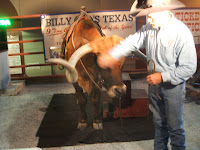
 Here he is! This is Gus (short for Augustus) and though he may not look like it - he is 100% real! A really pretty Longhorn and he just stood there patiently while people took their picture with him, or ON him as the case may be. I am totally a city girl and I was AMAZED how huge Gus was. Taller than his handler and wow, he's massive.
Not a bad way to end the evening. How much more Texan can you get? I'm exhausted. hehe
More later y'all...

 An afternoon of culture at the Dallas Museum of Art (DMA). Sitting around waiting for people to climb into this Hummer. That thing is about as long as an eighteen wheeler. Frankly, you have to bend over to walk to your seat and it has a kind of “porn lounge” feel to it; but I tried not to think about that. HA! As a side note, I am very excited to report that the DMA is one of the few American museums that is on the King Tut exhibit tour. It starts Oct 3 and I can’t wait to see it! WOOHOO.
 Next on the agenda – dinner at the 6th Floor Museum. A somber venue dedicated to the assassination of JFK but very interesting. Now located in the legendary Texas Book Depository, the exhibits are fascinating if not a bit morbid. They lay out actual known facts, cover conspiracy theories and currently have a very cool exhibit of home movies sent in from people who were there (with brief bios of the people who shot the footage). That exhibit is only there until mid-Oct so if you are in Dallas, go. I know it seems an odd place for dinner but even Dallas locals fail to visit the museum and it is very, very interesting. I did have to laugh at the poor museum worker who was being cross-examined by a visiting Canadian on whether the French audio tour was in proper French. Like that Texan knew! HA!
End of Day One.
 Day Two begins with a classic Dallas pastime. SHOPPING at a very posh store with Dallas roots. May I just say to the man in the lime-green Lamborghini - DUDE, the black shirt with flames along the buttons, open to your navel is NOT a good look. (I know, lime-green, it’s criminal! Sigh) Lovely afternoon sitting under a tree watching the “Haves” shop, until a bird decided to poop on my shoulder. Nice and classy. I am nothing if not classy ☺ Cleaned up and then onward to Ft. Worth (FW).
 A perfect Texas evening with a cool breeze on a rooftop terrace bar. Reata is a cool restaurant with a story and almost as locally famous as Joe T. Garcia's. (ohhh Joe T's. makes me want to move to FW just to be close to it) Sorry I digress. They serve delicious food and are located in downtown FW in Sundance Square. Man, I wish I could’ve stayed there all night! But no, alas, I am but a working woman and it was off to meet the star of the evening.
 Here he is! This is Gus (short for Augustus) and though he may not look like it - he is 100% real! A really pretty Longhorn and he just stood there patiently while people took their picture with him, or ON him as the case may be. I am totally a city girl and I was AMAZED how huge Gus was. Taller than his handler and wow, he's massive.
Not a bad way to end the evening. How much more Texan can you get? I'm exhausted. hehe
More later y'all...
Saturday, August 30, 2008
Something New
A strange phenomena seems to overtake people when they learn my husband is Italian. As in FROM Italy. All of the sudden, they come running to me looking for advice on where to go and what to do in Italy. It's flattering really, others thinking you an expert on something. HA little do they know.
That being said, I do LOVE to talk about Italy and have fallen in love with it since meeting my husband. It's a place I never gave much thought to until I met him. And now, I can really get passionate about the subject. Besides, I totally have an edge with my own live-in tour guide/historian who gives me a "local" point of view and knowledge. I am infinitely grateful for that! I haven't seen one-one-hundreth of the places in this beautiful country but I have been on the "roads less traveled" and I think, seen a very different Italy then many of my fellow travelers.
I've come to realize there are two types of travelers. Those who want to cram in as much as they can, hitting only the "hot spots" and spending little time in any one place. And those who want a slower paced trip, maybe seeing a few of the highlights but also spending time trying to experience the place and culture of the people. Both kinds of travelers are fine - it just depends on what you want to get out of the trip. I like to be the second kind of traveler though, preferring the side road trips to the small villages and towns that aren't overrun with tourists. It's with this in mind that I've decided to periodically post little featurettes about lesser known places in Italy which are interesting and worth a look if you have or care to take the time. (is "lesser known" correct grammar?)
Since I've rambled on and on, this first one will be short. It's a beautiful town at the beginnings of the Alps, not well known, no history of too much significance (that I know of) and utterly charming just as it is.
 Region: Veneto (Northern Italy)
Province: Treviso
City: Asolo
Asolo is a ancient pre-Roman town known for its glorious sunsets and beautiful setting. It's a very "medieval" town with walls that date back to the 14th century. It has a slow, relaxing pace which is conducive to nice meandering walks thru narrow streets, under porticoes and arcades.
It was inhabited by and/or inspired such literary figures and artists as Robert Browning (his last volume of poems - Asolando - named for the town); his wife Elizabeth Barret Browning; Henry James; Ernest Hemingway; Igor Stravinsky (composer) and Carlo Scarpa (architect).
Things to do here:
It's not big, but it is enchanting and evocative of days gone by as well as the affluence of today.
That being said, I do LOVE to talk about Italy and have fallen in love with it since meeting my husband. It's a place I never gave much thought to until I met him. And now, I can really get passionate about the subject. Besides, I totally have an edge with my own live-in tour guide/historian who gives me a "local" point of view and knowledge. I am infinitely grateful for that! I haven't seen one-one-hundreth of the places in this beautiful country but I have been on the "roads less traveled" and I think, seen a very different Italy then many of my fellow travelers.
I've come to realize there are two types of travelers. Those who want to cram in as much as they can, hitting only the "hot spots" and spending little time in any one place. And those who want a slower paced trip, maybe seeing a few of the highlights but also spending time trying to experience the place and culture of the people. Both kinds of travelers are fine - it just depends on what you want to get out of the trip. I like to be the second kind of traveler though, preferring the side road trips to the small villages and towns that aren't overrun with tourists. It's with this in mind that I've decided to periodically post little featurettes about lesser known places in Italy which are interesting and worth a look if you have or care to take the time. (is "lesser known" correct grammar?)
Since I've rambled on and on, this first one will be short. It's a beautiful town at the beginnings of the Alps, not well known, no history of too much significance (that I know of) and utterly charming just as it is.
 Region: Veneto (Northern Italy)
Province: Treviso
City: Asolo
It was inhabited by and/or inspired such literary figures and artists as Robert Browning (his last volume of poems - Asolando - named for the town); his wife Elizabeth Barret Browning; Henry James; Ernest Hemingway; Igor Stravinsky (composer) and Carlo Scarpa (architect).
Things to do here:
- Climb the 1,000+ steps up to "La Rocca" (the ancient wall in the pic below)
- Visit the castle of Caterina Cornaro, Queen of Cyprus born of a powerful Venetian family and a well known historical woman
- See the Roman amphitheater ruins
- Meander thru the open markets and shops
- Sit at a cafe or in the square, sipping Prosecco (wine made in this region), soaking up the atmosphere, watching the day go by
It's not big, but it is enchanting and evocative of days gone by as well as the affluence of today.
Oh I forgot. One interesting and a little bizarre fact - The Asolo Theater was taken apart by the Ringlings (of circus fame) and rebuilt in Sarasota, FL. Kind of along the same lines as the original London Bridge being in Arizona. huh interessttinngggggg
More later...
Subscribe to:
Posts
(
Atom
)